By Sharron Johnson
 July in Memphis can be a scorcher. No one can refute that. The temperature is well into the 90s and humidity turns the ambient air to a thick stew, so thick you could swear you could cut it with a knife. But I’m preaching to the choir. Plants and the planters are having a hard time keeping up with watering chores. Soaking rains are far and few between. In July you’d be hard pressed to get away with once a day soaking. I’m speaking from experience.
There are several ways to approach watering dilemmas, because you wouldn’t want to put in all the work of building a productive garden only to forgo it to the elements. One approach would be drip irrigation. A continuous drip of water keeps pots and beds at an optimum dampness, even in the driest of conditions. This kind of system hooks right up to your existing outdoor water delivery system and can be controlled by a timer. It’s a more advanced and costly way to corral those watering woes.
A second option is to use water retention pellets sold at many big box stores in the garden section. They can be added to the soil so that the plant can absorb and retain water. This product would be great for planters. I saw a life hack that uses the same principle as the pellets, but it suggests that the gardener use a disposable diaper. I can see that working just as well, especially on a wire basket hanging planter, with a coconut husk liner followed by the diaper then the soil. I’m trying this next spring.
Lastly, alleviate hot weather watering concerns with plant natives. They can be the best choice to conserve water and effort. Plant according to the care needs of the plant, i.e., sunny location with little water or wet conditions and shade-loving plants that may require dry or wet soil. The choices of plants are broad and aren’t like typical geraniums. Some natives appear to be a tad bit weedy in appearance and not so obedient. Bugs, butterflies, birds, and bees will flock to natives, sometimes all at the same time. If you attended the 2018 garden walk in May, you might have seen brightly colored kiddie swimming pools scattered about the neighborhood. They were filled with native perennials for all conditions. These pools were sold to encourage gardeners to give natives a chance. bought one and divided the plants into two pools. They are sitting on a dismal part of our garden, atop a crushed limestone parking pad. Nothing grows there in that scorching sun except those two pools, shining like a new penny tossed into a fountain. The native plants are growing very well and growing on me, too.
July is synonymous with Independence Day, fireworks, parades, and picnics. It’s also the time the hard the dirty knees and mosquito swats give their reward in a bounty of tomatoes and other tasty garden treats. Does it get any better than tomatoes eaten right off the plant?
Our July yard of the month, 1854 Felix, is sitting in the Southwest quadrant of Cooper-Young. Built in 1912, the charmer of a house sports a giant lone star encircled with a ring on the front porch wall, reminiscent of a branding iron mark. This home and garden is owned by Marie Dennan. a garden club member and garden tour participate for three years running now. While traveling west on Felix almost to McLean, sits this brick bungalow that has been painted white with a pale blushing blue/gray trim that is a perfect match to the standing seam metal roof. There is a full-length front porch with three brick porch posts divided equally across the entire span. The porch has a brick skirt, adding to the privacy and intimacy. An arched mouse hole located at the base of the wraparound adds to the charm of the porch along with the porch swing and conversation vignettes. Along the roof is a doghouse dormer that acts as a wedding cake topper. This garden isn’t about a perfectly edged lawn. It’s about low maintenance and a balance between nature, native, and non-native plantings. There is grass, but it’s largely left to its own devices. It’s got white clover and a variety of grasses, such as Bermuda, fescue and nut. The occasional dandelion or purslane, which are both edible, also co-exist in this free-for-all lawn. In this sea of green is a large (over six-foot tall) metal whirl a gig ready for any burst of breeze to entertain the inhabitants of the porch or anyone that passes by.
An old oak tree is to the left of this front garden, casting a shade that is welcome on these hot summers. A rounded trimmed forsythia acts as an anchor to the right of the space and a mature crepe myrtle that has been pruned to a shrub sits in a brick edged bed filled with many native sun lovers. A flower bed has been carved around the porch, and it too is filled with natives and azaleas. It is edged with Arkansas field stone. All the plants have been carefully labeled for education purposes. A mature Japanese maple is at the porch’s edge, creating yet another layer in this birthday cake of a garden. Zipping down the driveway on the west side of the tour is a row of some native plants thriving in the hot sun and in all that concrete water runoff. These hearty beauties are black eyed Susan’s, purple cone flower, comfrey, spider wort, Swiss chard, and swap iris.
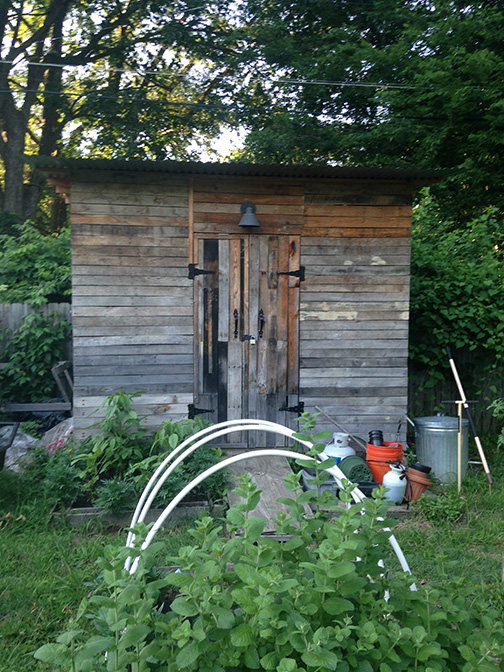
Entering the driveway gate to the back-garden turf grass, as in the front, is downplayed in favor of a multitude of raised beds made from used pallets sliced and buried to a six-inch exposure. I like that the cavity in the pallet is also filled with soil and plants. There are also beds made from the typical boards and scalloped brick edgers that intersect the corners of beds at any given moment like piped icing on a rectangle cake. All of these raised beds are full of edibles, herbs and flowers. A shed in the back of the property is also made from pallets that were disassembled and used for materials.
A large wire spool has been recycled into a table with a couple of white chaise lounges and a red umbrella. Off the back door is a brick patio for that morning coffee with nature. There are so many different kinds of plants in this back garden. The birds, bees, bugs, and humans feel like they’ve entered the Garden of Eden. So many plants that there will be a list.
 Let’s meet Marie:
Marie, I know that you aren’t from the Memphis area. Tell our readers where you are from and what brought you to our fair city?
My family is originally from New York City. My family moved to California when I was 9, and a couple others places in the early 2000s. I followed my parents to Memphis in 2006 after I had been working as a pastry chef in London for 10 months. I started at the University of Memphis in 2007 and have lived here ever since.
What are your talents, passions, and hobbies? What do you do for a living?
My favorite hobby is cooking. I have always liked to cook and that passion has grown since I have lived in Memphis and started shopping at the farmers markets. Now I cook with food I grow myself. I also love to dance and have been involved with Project: Motion for the last five years. I enjoy all the arts in Memphis, parks, bike riding, and enjoying different cuisines in Memphis. I am the program manager for the nonprofit Big Green Memphis. Big Green has partnered with 110 school in Memphis, providing them with learning gardens and ongoing educational support. It is an amazing opportunity to work with the Memphis community and be a part of the engagement and connections school communities are having through growing their own food.
Why did you choose Cooper-Young to be your landing spot and when did this take place?
When I was looking to buy a house I knew I wanted to live in Midtown and have a sunny backyard to build a garden! I just happened to find a great house in Cooper-Young and bought my house on Felix in June of 2015.
Have you always been a gardener?
I started gardening when I moved to Memphis. Growing up, I remember my grandmother on my mom’s side and my grandfather on my dad’s side having gardens in Staten Island, NY. They were also both great cooks! I remember picking green beans off my grandmother’s fence and blackberries on our walk to the corner store. My grandfather was more interested in perennials. Cooking with food from the Memphis Farmers Market sparked my interest in growing my own food to cook with.
Any pass along plants from friends or family?
A friend recently gave me some red malabar spinach, which I found out is not actually a true spinach and grows very well in the summer and vines. I have also been gifted plants from Susan Wallace at Midtown Herbs (Cooper-Young Community Farmers Market) and Wolfgang Marquardt (downtown farmers market) from Gardens Oy Vey to contribute to added perennials and native plants to my vegetable garden.
Tell us what your yard was like when you arrived and some of the changes you’ve made.
My yard was just a big patch of grass, and there was some pretty landscaping in the northeast corner that got some shade. Some rose bushes, hydrangeas, a butterfly bush, and three crepe myrtles. I used to have chickens that lived in that shady corner so I did not pay much attention to that stuff but it lived alright. Probably got plenty of fertilization! Now that the chickens have moved onto “greener pastures,” I am reclaiming that space and enjoying the ornamentals my house came with that I scoffed at a bit at first! Although, I accidentally killed the butterfly bush, which I regret now, and cut down the three crepe myrtles, which I don’t regret. I planted a pollinator garden where one crepe myrtle used to be in the front of my house and planted a fig tree and am deciding what else I will plant to replace the third one in the backyard. I built raised beds for a vegetable garden the first fall I lived in the house, and the second biggest project I did this winter was remove the privet hedges in front of my house and plant a variety of natives. I planted some hydrangeas, a spice tree, spider lily’s, Jacob’s ladder, and sweet spire. There was a forsythia and hostas already there, that I left and appreciate. I also built some raised beds along the west side of my fence to plant perennials, and a bottlebrush and redeye buckeyes.
 What are your future plans for your garden?
My future plans are to build back up the corner where the chickens used to live and make it more of a meditation shade garden! That might be a great spot to put the firepit as well! I also want to take over some more spots in the front yard and landscape with low maintenance plants.
Your garden has many different aspects, such as flowering plants, edibles, trees, and shrubs with little to no lawn. Tell the reader why they should consider the same.
I really like to play in the dirt, and I feel creative and also empowered in growing my own vegetables. I want to reduce my waste on the environment so I do not do much to care for my grass and let all the wild things that want to come up come up and then cut it only when it is a bit unruly. I have noticed bugs like the clover and dandelion flowers that pop up everywhere in spring. The main reason I incorporated so many perennials into my garden this year was to attract good bugs and support plants that will attract pollinators to my vegetable garden.
What is your favorite part of your garden, favorite plants, and why?
Oooh, this is hard. Right now, I would say my herb garden and the New Zealand spinach that I am also trying this summer; it’s growing strong and so tasty. I am most interested in the things I can eat!
You’ve participated in the garden walk now for several years. Tell the readers about your experience.
I have enjoyed sharing my yard with people on the garden walk. I learned more things about my own yard and have been inspired by the neighborhood’s enthusiasm and passion for the walk. People have identified plants for me, and I believe I have inspired some people to take a chance and start gardening. I was honest about my challenges, and over the years people have seen the progress of what I have done, which can be inspiring for someone to realize they can’t create the amazing yards they see on the garden walk over night! It might take year, decades probably for some!
If you could give advice to an up and coming gardener, what would it be?
I am not going to say start small, because I definitely did not do that. How about, be modest in your first approach. Whatever modest is for you! I built three 4×4 beds, two 4×8 beds, and one 3×6 bed. It took some time and it was fairly manageable but over the years I have learned some things:
1) It is okay to let some beds rest for a season and plant cover crops
 2) It is okay to plant lots of flowers, intermixed with everything else, or just have larger areas of zinnias, cosmos, or marigolds in the garden. The flowers really add a beautiful pop to the garden, and it is joyful to give flowers to friends or bring them to the office or place around my own house.
3) It is okay to let stuff go to seed, unless the plant is heavily infested with a harmful bug or a disease. Otherwise, seeing what lettuce, collards, radish, and turnip flowers look like when they flower is really cool. The little yellow brassica flowers are some of my favorites. You can just let them be or cut them for the flowers, save the seeds, eat some of the flowers, and you will also be supporting the beneficial insects.
4) It is okay to start with just raised bed, especially if you have not gardened before. Whatever season you start, plant seeds and seedlings of food you know you will eat and then maybe a thing or two that are different that you want to try. You could start a theme to keep you engaged, like a spring salad garden with spring onions, lettuce, radishes and carrots, or summer pasta garden with tomatoes, peppers and basil.
5) Build a garden that you have time to water or set up an irrigation system. Because if you build it too big for your capacity, it will be frustrating to keep it thriving. I learned that and am finally going to test an irrigation strategy since I have so many new spots to get watered. Sprinklers can also work, especially if you have grass, but just be aware of everything the sprinkler will hit in case there is stuff you don’t want to always get watered.
6) Have fun. I was pretty squeamish around bugs until I was 29. I enjoy gardening so much I had to overcome it. Now, I think learning about bugs is cool. I still wear gloves a lot to work without having to make direct contact with some insects but seeing all the life a garden can bring to a space if fascinating.